
On god(s)
Do I consider myself a religious person? Nah. Do I think mystics are cool? Extremely.
I’ve never particularly believed or disbelieved in God. There are two churches that I remember from growing up, both of which float in my mind as seen from the outside: small white buildings which the road curves around. A vague memory of candles at night. A kids’ Bible song that sounds a lot like the chorus of “Wannabe” by the Spice Girls. God didn’t really live there for me.
By the time I attended a Catholic high school, my teenaged self politely viewed religion as a protracted anthropological experiment. Now I consider myself an agent, very awed speck of dust in a universe expanding beyond our reckoning in a shape we can’t hope to describe—but I’m not a religious person, or even a very spiritual one.
Which is why it’s surprising to me that organized religion has come to play such a significant role in my book. And yet the more I think about it, the more it kind of...makes sense?
A tool for coping with crisis
The world of the novel is one that experiences regular cataclysms—think extinction-level events, the comet that killed the dinosaurs, the kind of wacky stuff we see on exoplanets that rain molten glass sideways. In this world, how could knowledge be preserved from one Year to the next? How would you explain these cataclysms if knowledge wasn’t inherited, or only partially inherited? What paradigms are necessary to cope with such a world?
Plenty of people have done plenty of thinking on the apparent dichotomy between science and religion, and on the places where that dichotomy collapses. These collapses interest me more. What does a belief system look like that treats something we’d consider hard scientific fact as if it’s a miracle, or proof of some active divinity? What do miracles look like when they’re ordinary scientific data put through dry calculations to inform policy decisions? Where these two concepts—religion and science—overlap, they create a sense of the world that expands rather than contracts when confronted with new & conflicting information. I wanted to create a world where there wasn’t ever a dichotomy to begin with, only conflict over what to do with the knowledge being received. That strikes me as a much more universal and complicated problem.
This worldbuilding process led me to a sense of religion that has its own organized elements—holy bodies, hierarchies, sacred texts, etc.—but that actually trends more towards mysticism than anything else. Which is doubly cool! Because as these characters are experiencing faith-as-mysticism, I’m experiencing something not too dissimilar.
Storytelling as mysticism
In a previous post, I mentioned mysticism in the context of weirdness because female mystics (especially the large corpus of medieval ones) were excellent at weirdness. If you’re a mystic, you’re someone who experiences a state of ecstasy, where your sense of self disappears completely into a divinity or cosmic understanding that is impossible to approach any other way. These experiences overwhelmingly arise from a religious life or thought-structure, but they’re not necessarily beholden to that structure. In trying to communicate these experiences, mystics are trying to put language to something that is fundamentally beyond language, and so beyond structure. (Which is weird!)
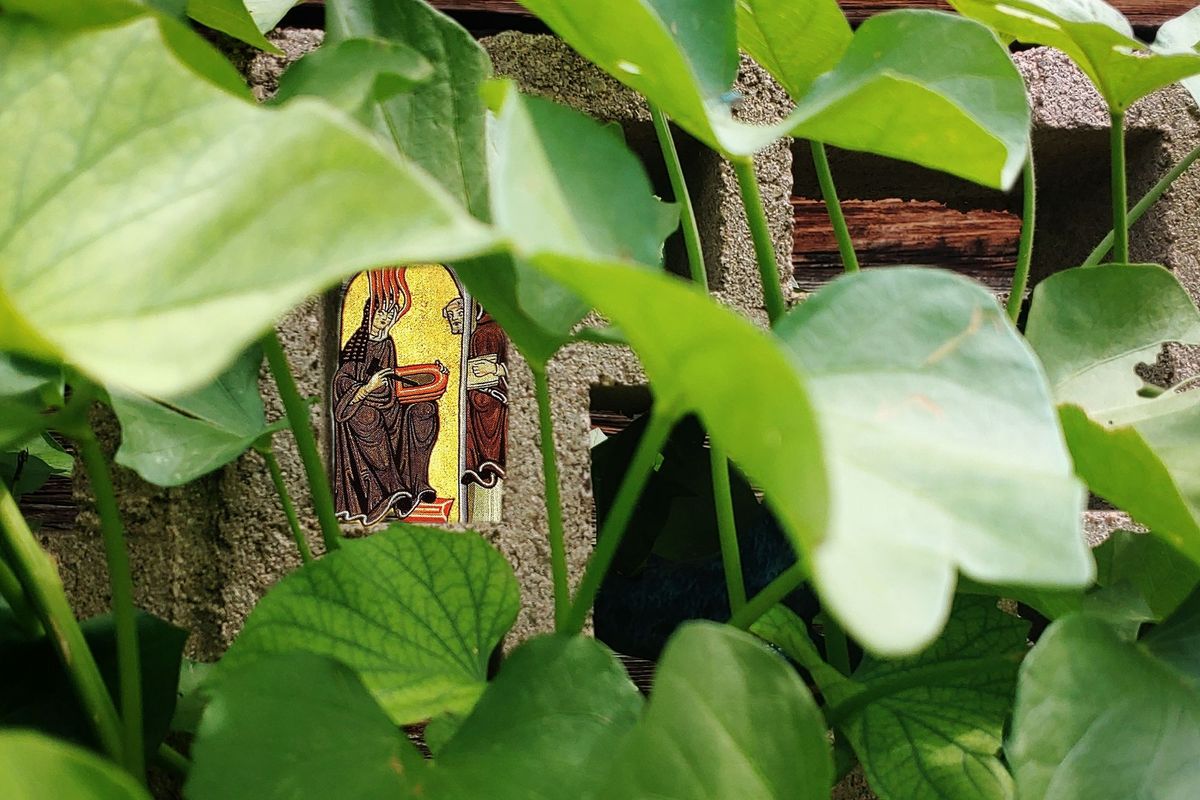
Hildegard von Bingen, who I’ve mentioned before because she fascinates me, experienced numerous visions throughout her long, strange, productive life. (Today’s header image is a collage of Hildegard receiving one of her visions, illuminated in Scivias, the first of her three works on the subject, as transplanted into my family’s garden wall.) Though she’d experienced these visions since she was a child, Hildegard didn’t record or share them until she was in her 40s and struck by illness, believing that the illness was a sign of God’s displeasure with her reticence. In a letter seeking advice from a respected abbott, she says:
I am very concerned by this vision which has appeared to me in the spirit of mystery, for I have never seen it with the external eyes of the flesh. I who am miserable and more than miserable in my womanly existence have seen great wonders since I was a child. And my tongue could not express them, if God’s Spirit did not teach me to believe.
Let’s just set aside the whole subject of early medieval concepts of gender, since we don’t have time for that here, and focus on her anxiety: my tongue could not express them. She does in fact go on to express those wonders, of course—but this is the solidarity I feel with her. I am also trying to describe something that is impossible to describe. That’s what writing is! I have this whole story in my head, it’s been there for so hilariously long, it grows more defined by the day, and yet sometimes (frequently) it feels like words on a page will never be able to translate it.
At home in the labyrinth
I’ve been thinking a lot lately about this passage by Simone Weil, a 20th-century mystic, from her work Waiting for God.
The beauty of the world is the mouth of a labyrinth. The unwary individual who on entering takes a few steps is soon unable to find the opening. Worn out, with nothing to eat or drink, in the dark, separated from his dear ones, and from everything he loves and is accustomed to, he walks on without knowing anything or hoping anything, incapable even of discovering whether he is really going forward or merely turning round on the same spot. But this affliction is as nothing compared with the danger threatening him. For if he does not lose courage, if he goes on walking, it is absolutely certain that he will finally arrive at the center of the labyrinth. And there God is waiting to eat him. Later he will go out again, but he will be changed, he will have become different, after being eaten and digested by God. Afterward he will stay near the entrance so that he can gently push all those who come near into the opening.
At this point, I feel like I’m turning around in the labyrinth, trudging gamely for the center. Unlike Weil, I feel like I do have light—the abundance I talked about in On process is like torches I’m carrying with me.
But the part of this quote that makes my brain rev up is the last bit, where the person who’s survived the labyrinth (of God, or storytelling, or whatever power sits in the middle for you) gently pushes others towards it. That’s what’s motivating to me. It’s what I’m trying to do to all of you, once this dang thing is published: to hope that what’s changing me might change you, too.
Until next time, friends.
—Rachel/on the couch/Tucson AZ/Oct 1, 2022
(the partial catalogue of cool, pt. iv)
- This chilling video about the immediate aftermath of Chicxulub, the asteroid that killed the dinosaurs (I suspect the creators edited it to be 13 minutes and 13 seconds on purpose)
- This 13th-century Icelandic hymn as sung in a train station
- When God Is Gone Everything Is Holy