
On process
Six months in, let’s take a look under the hood.

Lately I’m finding that it’s easier for me to describe changes in my life the further away I get from them. It feels like the right language only appears once I’ve gotten to a certain spot after the point of transition—like a seesaw that only moves once you sit on the far end and not right up on top of the fulcrum.
The reason I’m bringing this up is because it’s only now, a full 170-ish days since I started this project for real, that I’m able to really articulate the process that’s gotten me here. Don’t get me wrong! You better believe I’ve been putting together pieces of it the whole time, like a toddler dizzy with triumph connecting her first jigsaw puzzle. But it’s only now that I’m starting to see the whole picture—the whole ProcessTM.
I want to talk about this for a couple reasons. One, it’s materially helpful to me: putting the pieces together on this page rather than just in my head means I can understand & apply things better. Two, I want anyone among you who’s working on a big project—whatever that may be—to have the chance to poke at what I’ve learned, to see if any of it’s helpful to you or not.
So! Here’s how things developed.
The whiteboard (planning)
Way back in ye olden days of March 2022, I asked my one partner to help me put together a work schedule for the novel. They’re a teacher (and a PhD candidate, godspeed), and they’re really good at keeping track of insane amounts of information each semester using their trusty whiteboard method.
I had literally never planned something like that in my life, ever. I’m a recovering procrastinator; traditionally, big projects have meant blurry all-nighters in the eleventh hour. (Sorry to all of my teachers, ever, and also to myself.) It’s taken me a while to understand that I procrastinated because I needed the sense of nauseating panic induced by a looming deadline to help me prioritize a task—something I struggle with, since everything tends to feel equally important to me.
But my partner helped me reframe things. What does work look like when you do it in steady reasonable steps over a long period of time? What are your daily goals? Your weekly goals? How are you going to break down the types of work you need to do? How do you want to reassess and adjust? When is your absolutely sacred time off? What’s your first important benchmark—something we can celebrate with you?
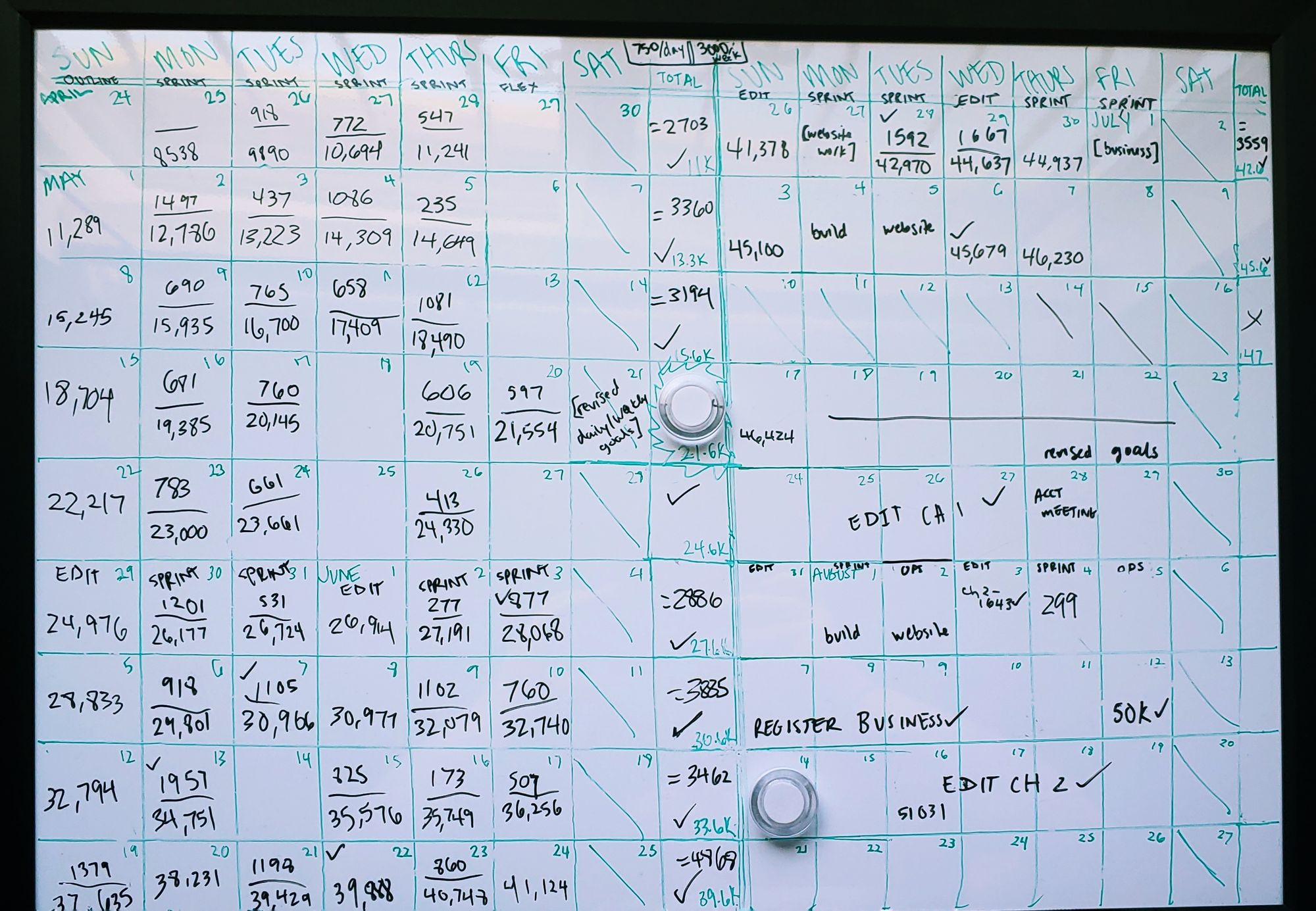
Turns out, this kind of schedule works really really well! For me, at least. It gave me routine, rest, and reward. I watched my word counts explode from week to week. You can see where the shape of my work changed in late July—I fell into a slump, and I shifted focus to building this website and launching my business—but for the first big leg of the project, the whiteboard helped me generate and maintain a huge momentum.
The GripTape model (mentorship)
I work as a youth mentor (aka Champion) for the nonprofit GripTape, which you should absolutely check out. My job is to be a cheerleader and sounding board for teenagers doing all kinds of incredible things; a lot of this is asking thoughtful questions, and a lot of it is just being interested in their projects. Which is easy, because they’re amazing.
Having seen how much it helps these youth to have a champion in their corner, I asked my uncle (who actually founded GripTape and is a Champion himself) if he’d do the same for me. We’ve met weekly since mid-April, and I’m reaching gently through your screen to take you by the shoulders and tell you with extreme seriousness what a difference it’s made for me. Our conversations help me vent frustrations and self-doubts. They help me step back and appreciate my successes. They help keep me excited and motivated throughout the most ambitious project I’ve ever undertaken.
But I think the most important thing to come out of these conversations is articulation and context. I used to write based purely on vibes; now I write on vibes and the deliberate use of helpful strategies, which exist as such because I had to articulate them to someone. And as I talk through updates, I’m able to scoot to one end of the seesaw and recognize the work I just did on the other end—to put it in context, to shape it into little seasons of abundance or struggle or reorientation that help me figure out where to go next.
(I’m deeply fortunate to be in this position—to give and receive mentorship, and to have so many deep wells of passionate interest to draw upon in my life. This is connected to a lot of my thoughts about writing communities, but I’m saving those thoughts for another post because there’s a lot of ’em.)
Ebbs & flows (reflection)
Okay, so here’s where the header image comes into play. Ta-da! It’s almost like I planned it.
I’m finding there are so many natural ebbs and flows in my process, and I’m learning to embrace them and work with them instead of trying to steamroll past them for the sake of progress. Because I’ve set up these structures where I’m reflecting frequently on my work, I’m also starting to react to those reflections. Are you stalled on the actual book text? How about you noodle around in some of the supporting text instead: do some characterization exercises, poke at some plot sequences, worldbuild. Are you getting burned out by writing sprints? Try to edit for a bit. Bored by the minute logistics of how to get characters from point A to point B? Step back and look at things from a thematic level. Feeling like there is no drop of joy left in this story? Go read or watch or play a story that’ll get you hype again.
Sick of the whole damn thing? Go do something completely different. It’s not like you have a shortage of ongoing projects, Rachel.
I picture these questions like a laser ping-ponging back and forth between mirrors. It’s actually really reassuring to me to think that I’m not really stuck on anything; I just need to catch up with where the light’s naturally bounced off to now.
Finally, a key thing I want to emphasize: this work would be impossible without the generosity and support of other people. I could be the most disciplined, passionate, creative writer in the history of the universe, but if I’m not getting human input, I’m not going to produce any kind of human output.
But here we all are, all our works somehow moving together in ways we might not even realize yet! And I think that’s really neat.
Until next time, friends.
—Rachel/in the shop/Tucson/September 22, 2022
(the partial catalogue of cool, pt. iii)
- Yayoi Kusama’s Infinity Mirror Rooms
- The Eternal Jukebox, a tool that lets you plug in a song and see how it can loop (almost) infinitely within itself
- Björk on creativity from a six-year-old Reddit AMA